A solid wood tabletop may be flat and dry on the day it is fastened to its frame. The trouble can begin months later, when indoor air changes and the top wants a different width. A row of screws fixed tightly across its grain tries to keep the old width in place. Wood can resist for a while. Then a joint opens, the top cups, or a crack follows the grain. The failure may look like poor glue or weak timber, but the fastening has asked the top to stop being wood.
The movement is not a defect that can be sanded out. Wood exchanges moisture with the air until it approaches a balance with its surroundings. Seasonal changes in relative humidity shift that balance. The US Forest Products Laboratory's Wood Handbook chapter on moisture describes this exchange and the resulting dimensional change. A finish can slow the exchange, but it does not make it cease. A table carried from a dry shop into a damp room has not crossed into a place where its dimensions are fixed forever.
The direction matters more than the season
Wood does not change equally in every direction. It moves very little along the grain of an ordinary board, and much more across it. Within that cross-grain movement, change parallel to the growth rings is generally greater than change across them. The Wood Handbook documents those radial, tangential and longitudinal differences and explains why boards can distort as well as change width. The exact amount depends on species, grain orientation and moisture change; a universal gap for every table would hide those variables.
A glued-up top made from long boards usually has its grain running the length of the table. Its length then changes relatively little with humidity, while its width may change enough to matter at the aprons beneath. Those aprons run around the frame and hold their own dimensions mostly along their length. If the long apron fixes the top at several points across the top's width, the two pieces disagree about how far apart those points should be in the next season. Something must yield.
The argument does not require green lumber. In the Forest Products Laboratory's drying and dimensional-change chapter, William Simpson notes that wood in service is nearly always changing moisture content a little. Daily changes tend to be small; gradual seasonal changes deserve more attention. Drying stock near the conditions in which the finished table will live reduces the size of the surprise. It does not erase the need for a joint that tolerates later movement.
Hold it down without pinning its width
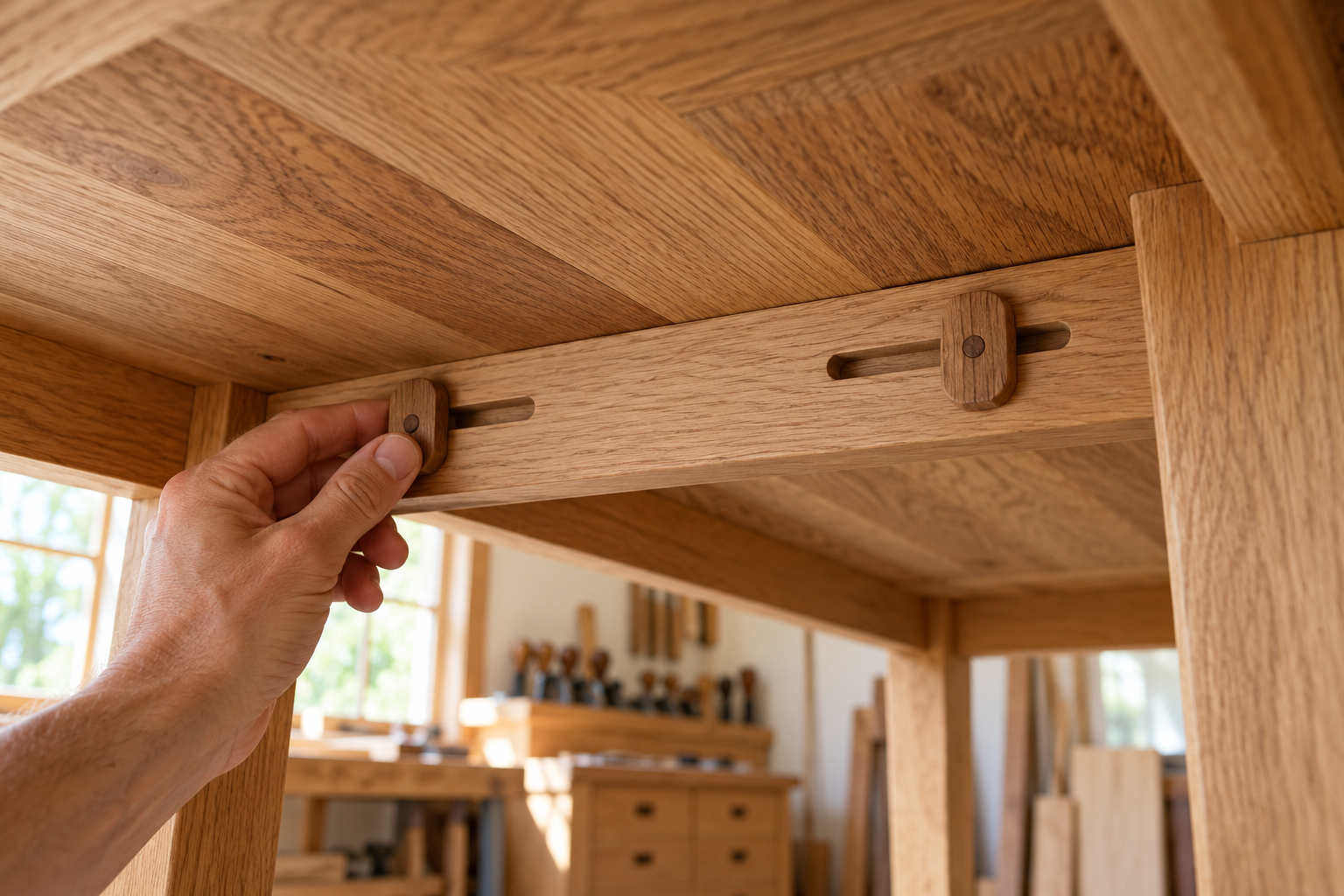
A tabletop still needs a firm connection to its base. It should not lift when someone leans on an edge or shift when the table is moved. The solution is to hold it down while letting the relevant points slide across the grain. Furniture maker Nancy Hiller's account of wooden buttons shows one way: a small block screws to the underside of the top, while its tongue sits in a groove in the apron. The tongue restrains lift but can travel in the groove as the top's width changes. The groove must leave room in the direction the top actually moves; a button jammed against the end of its travel has lost the feature that made it useful.
Other fasteners make the same bargain in different forms. A slotted hole in a rail lets a screw shank move sideways under a washer or screw head. A figure-eight fastener rotates slightly as the top changes width. Christian Becksvoort described these and other attachment choices in his 1987 furniture-making account, prompted by a table he had rigidly glued and screwed to its frame. His example makes the cause visible, though the particular table's damage cannot set a movement allowance for another species and room. The mechanism is what transfers: a fastener can pull parts together without fixing every dimension between them.
The choice of a reference point matters. One point or a line near the centre can locate the top on its base. Other connections can then give it room to expand and contract outward. If all the allowance is placed at one edge, that edge may move visibly while the opposite edge stays registered; this can be acceptable or awkward depending on the design. For a top set inside a surrounding frame, a maker must leave enough clearance at the sides as well as use movable fasteners below. Hidden travel in a screw slot cannot prevent an expanding board from pressing against a rigid border.
A number is a range, not a promise
It is tempting to take one species' published shrinkage value, multiply by a tabletop width, and cut every slot to the resulting fraction. The value is useful, but it describes a material and a moisture range, not the future climate of the finished room. In a 2022 Forest Products Laboratory study, researchers measured width changes in four kinds of solid wood flooring as humidity was cycled. Their measured dimensional-change coefficients varied enough that they recommended reporting them to two significant figures. Flooring is not a table, but the experiment is a useful check on false precision: even carefully measured wood does not supply one exact movement number for every board.
The direction and scale of the slot or groove should therefore follow the grain, expected moisture change, top width, and the fastener's starting position. A long top may need little longitudinal freedom but appreciable room across its width. At assembly, check that a button or clip can still travel toward both the drier and wetter states the piece might see. Bill Hylton's tabletop fastening guide describes leaving a gap behind a button's shoulder rather than wedging it against the apron. The gap is a working part of the attachment, though its size has to fit the actual build.
Finishing both sides of the top is often sensible for a more even response, but finish does not replace the moving connection. The Wood Handbook says varnish, lacquer and paint retard moisture changes rather than prevent them. If a top is fixed hard across its width, a slower change may simply postpone the strain. Likewise, switching to a different screw does little if the screw remains trapped in a round hole that cannot move.
The tabletop needs room because it is both furniture and a piece of a once-living material. The base must support it; the top must remain free to take up and release moisture at its own pace. A well-made attachment does both jobs. Its small hidden slide is what keeps the broad visible surface unbroken.

A thought worth keeping?