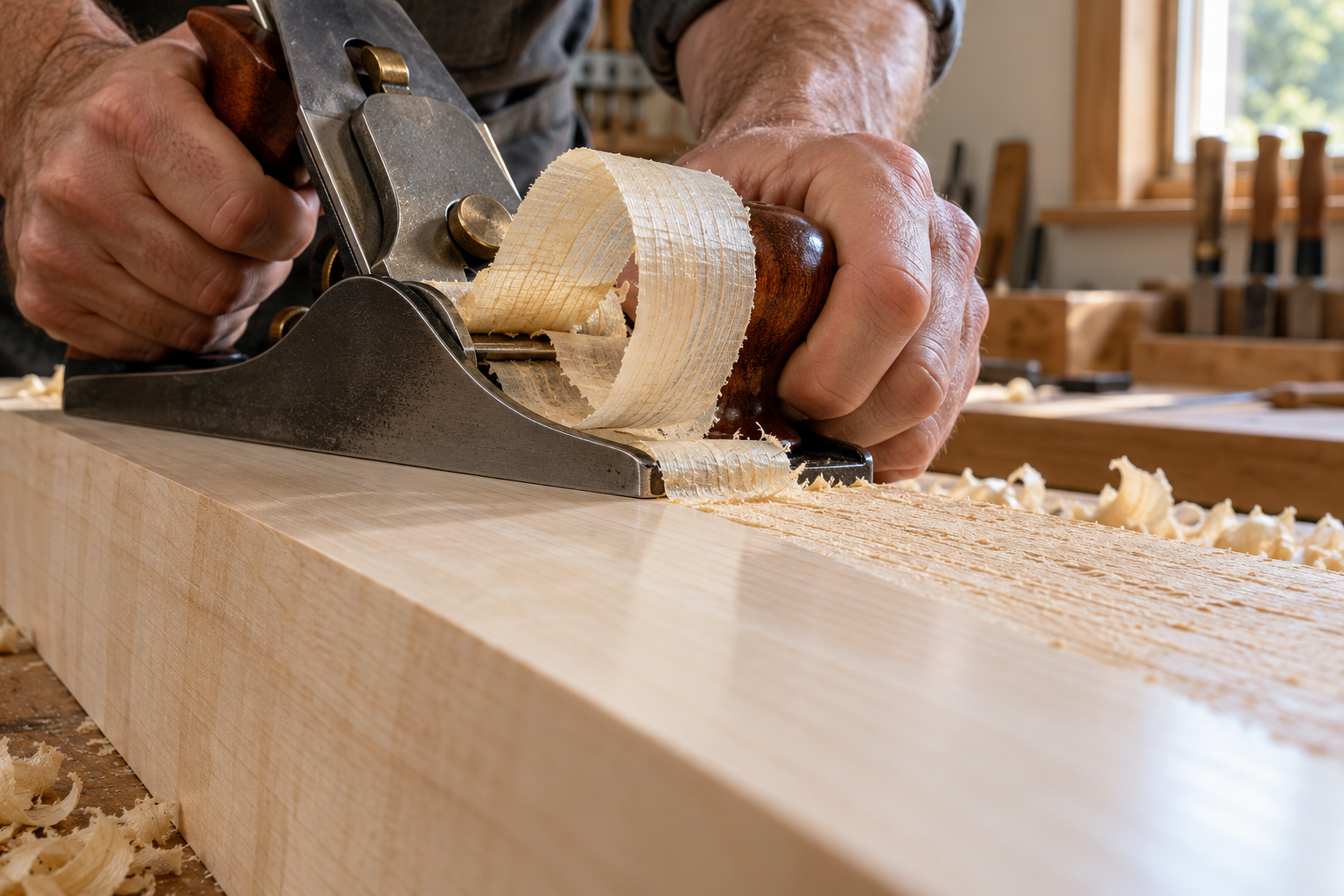
A plane blade does its work at a line too small to see clearly while the tool is moving. Behind it, a shaving curls away; below it, the new wood surface appears. A clean shaving can make the action look effortless. It is not. The blade has to separate fibres that run in different directions and may be tied together differently around a knot or a change of grain. Sharpening changes that encounter, but the blade's edge is only one part of the cut.
The difference is easiest to feel when a plane stops slicing and starts pushing. A rounded edge can press and bend fibres before it severs them. The Forest Products Laboratory's finishing chapter describes dull machine-planer blades crushing softer earlywood beneath denser latewood on some flat-grain boards, with the damaged surface sometimes rising later. That is a particular industrial defect, not a diagnosis of every rough hand-planed board. Yet it shows what a blade can do besides cleanly cut. A freshly honed iron can still lift a long splinter ahead of itself if the grain runs out toward the surface. A good result needs a sharp enough edge, a suitable depth, a way to control the chip, and attention to the wood under the sole.
What leaves the board
Wood is not a uniform material that yields as a metal sheet might under a cutter. Its long fibres and weaker bonds across them let a split run ahead of a blade. In an original Forest Service cutting study, G. E. Woodson measured forces and observed chips while cutting samples from 22 southern hardwood species at different rake angles, moisture levels and depths. Deeper cuts generally demanded more force in the direction of travel, and species density mattered. The measured effects varied with cutting direction and conditions. The paper studied controlled orthogonal cuts, not a person planing a table by hand, but it shows why the thickness of a shaving and the material beneath it cannot be ignored.
John Nairn's bench-plane model makes the hidden split more explicit. It represents a crack advancing through the wood as the blade lifts a chip, while the sole, mouth opening and chip breaker also contact it. The model found that depth of cut, the position of the chip breaker and the mouth opening interact. Those are virtual experiments, checked against an analytical model, not a set of settings to copy onto every plane. They explain why moving a cap iron closer or taking a thinner shaving can change the fracture even when the honed edge itself has not changed.
Cutting against rising grain is especially revealing. The fibres ahead of the blade may split below the line it was meant to leave. In Nairn's bench-plane simulations, bringing a chip breaker closer changes how the lifted shaving bends and how the crack travels. The model stops short of prescribing a universal distance between the two edges. It supports the narrower mechanism: controlling the chip can change a split that sharpening alone cannot prevent. A sharper blade does not make the fibres ahead of it incapable of separating.
Sharpness changes one part of the force
Sharpening reduces the radius and irregularity at the cutting edge. That makes it easier for the blade to begin severing fibres at the intended line rather than bruising them first. An industrial planer offers a view of what happens as an edge wears. In a 2019 study of pine window-frame elements, researchers followed tool life and measured surface quality as planing blades worked through glulam pieces. Surface texture and blade material changed over the production run. Industrial cutterheads, feed speeds and glued pine pieces differ from a bench plane, so their wear rates are not a hand-tool sharpening schedule. They are evidence that the edge is a changing component, not a fixed setting.
Nairn's model adds a useful caution. Within the rounded-tip sizes it simulated, the change in cutting force from sharp to blunter tips was relatively small compared with some changes in the other cutting conditions. It did not measure whether a person would like the resulting surface, and it represented the blade as a rigid body rather than following real wear. A sharp blade may improve control and surface quality without a large change in a model's total force. It is more honest to inspect the wood and the shaving than to declare a tool sharp enough from the effort of one push alone.
The board adds its own limits. In a 2016 experiment on Scots pine with knots, researchers found less chipped and torn grain near deviating grain when they moistened the surface shortly before machine planing. That result is specific to their samples and treatment, not a general instruction to wet furniture before using a hand plane. It demonstrates that local grain, density and moisture can change the same cut. A lighter pass and a changed planing direction may help when the fibres reverse; neither replaces a sound edge.
Read the surface after the pass
A long, continuous shaving is useful feedback, but it is not a certificate. Look closely at the board. A clean surface shows fibres cut at the intended level. Torn grain leaves tiny pits where a split ran ahead and below the blade. Fuzz suggests fibres were bent or pulled rather than cleanly severed. Ridged tracks may come from a nick in the edge or an uneven setup. A rough patch only around a knot suggests a different local cause from a rough strip across the whole width.
Machine-planing studies reinforce that distinction. In a 2024 test on fir, poplar and beech, changing feed speed and depth produced different measured surface roughness, and the species responded differently even when machining conditions were held alike. Its cutters and millimetre-scale depths are not settings for a hand plane. They show that a smooth result cannot be assigned to sharpness in isolation. The cut is an interaction among blade, wood and how much material is asked to leave at once.
On a bench plane, make the next adjustment answer the defect you can actually see. If the edge is rounded or nicked, hone it. If the edge is keen but a split runs ahead where the grain rises, reduce the shaving, consider how the cap iron and mouth guide it, or approach from the other direction if the board permits. If the sole is rocking or the board is unsupported, first give the tool a stable path. A single heroic deep pass is rarely worth a clean surface lost at its end.
The changed wood is the final evidence. Sharpening gives the blade a better chance to cut at a precise line. The board, the shaving and the plane's setup decide whether it succeeds. A skilled hand listens to the resistance, then looks at what the fibres left behind.

A thought worth keeping?