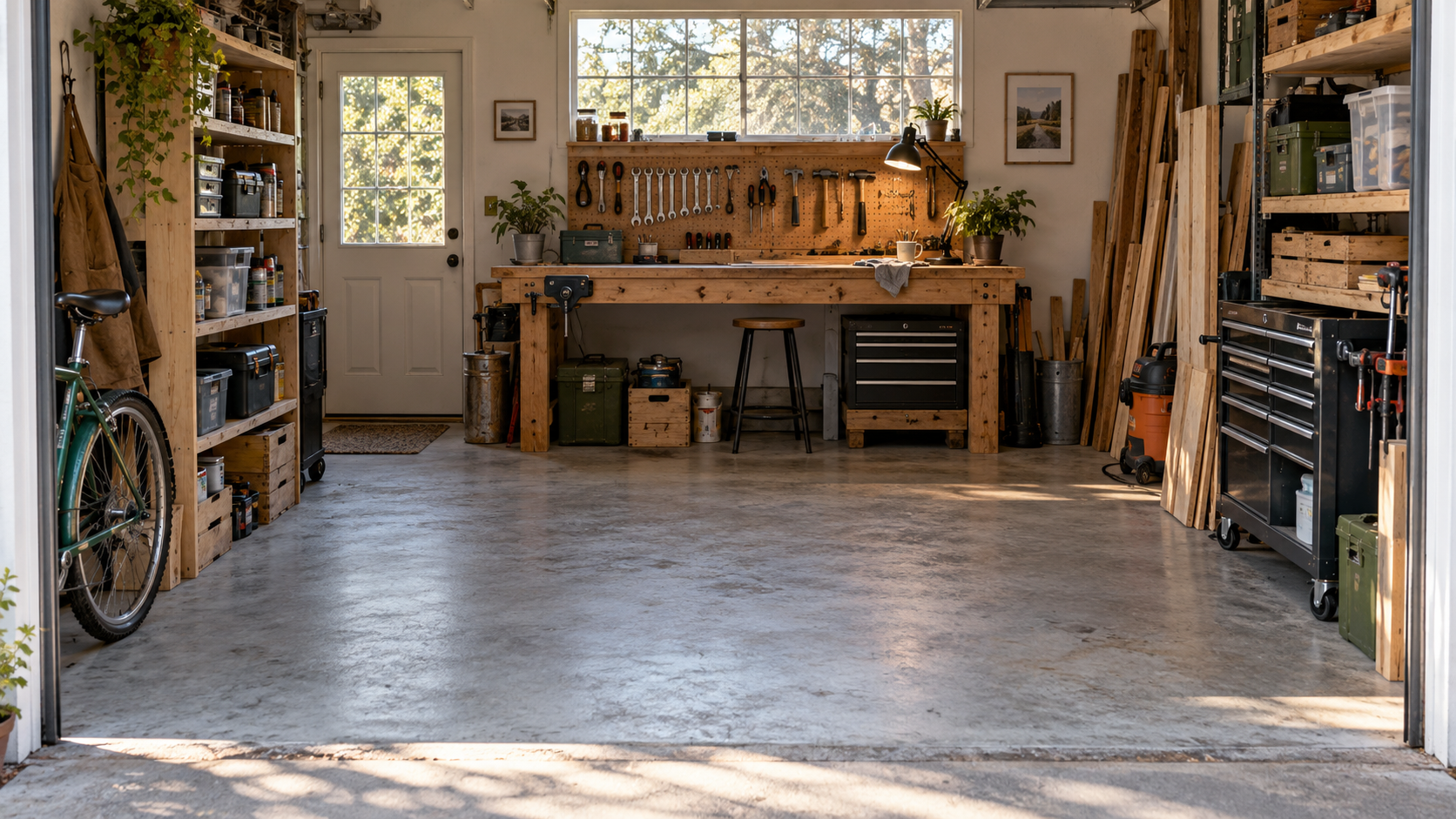
There was nowhere to stand in my workshop. I had a bench, tools, three promising projects and enough offcuts to suggest I was preserving a forest by installments. To reach one useful object, I moved two other useful objects. The garage had become a very small obstacle course with excellent intentions.
I considered buying a better storage system. This was a suspiciously convenient interpretation of the problem. Buying something is easy to imagine. Deciding what should leave a room involves more actual thought.
The improvement that finally mattered was an empty square metre of floor. No product photograph can do much with that, which may explain why it took me so long to appreciate it.
Draw the journey through the room
I sketched the garage and marked the things I did most often. Enter carrying materials. Put something down. Reach the bench. Find a tool. Return it. Carry a finished piece out. The drawing was ugly and useful. It showed that I had been storing objects in the places where movement needed to happen.
A room can contain everything required for a task and still make the task awkward. I see the same thing at work: an item is technically available, provided someone is willing to perform a little search-and-rescue operation to retrieve it. The presence of a possession is not the same as convenient access.
I cleared the route before reorganizing the shelves. That order mattered. Otherwise, I would have created very neat storage around the same awkward journey. I also separated a genuinely active project from a pile I had been describing as active because it was embarrassing to admit I had lost interest.
Some materials went to another maker who actually wanted them. Some were sorted for the appropriate local disposal route. Useful offcuts received a limited place, rather than permission to occupy any surface they could reach.
Let the room have a capacity
The new rule was not that I could never keep a spare piece of wood. The rule was that the offcut space had a size. When it filled, I had to make a decision before adding more. The garage was not going to expand merely because I had used the word potentially.
I moved frequently used items close to the work they supported and kept their resting places recognizable. An object with a clear home is less likely to migrate into the middle of the floor. The system also had to survive the end of an ordinary tired afternoon, when my appetite for elegant categorization falls considerably.
This was organization, not a substitute for safe workshop practice. Clear access, sensible storage and attention to equipment instructions still matter. I did not treat a tidy photograph as proof that every arrangement was appropriate for the work taking place.
The first project after clearing the floor felt strangely easier. I had not become more skilled overnight. I simply spent less attention negotiating with the room. I could set something down without inventing a new location. I could see what needed doing next.
The empty square metre remains impressively unphotogenic. Sometimes a box tries to settle there. Sometimes I catch myself imagining a machine that would occupy it very nicely. Then I remember the afternoon when moving a shelf required moving nearly everything else first.
A modest workshop deserves room for the person who is doing the making. Mine finally contains that person without requiring him to climb over his optimism.
A thought worth keeping?